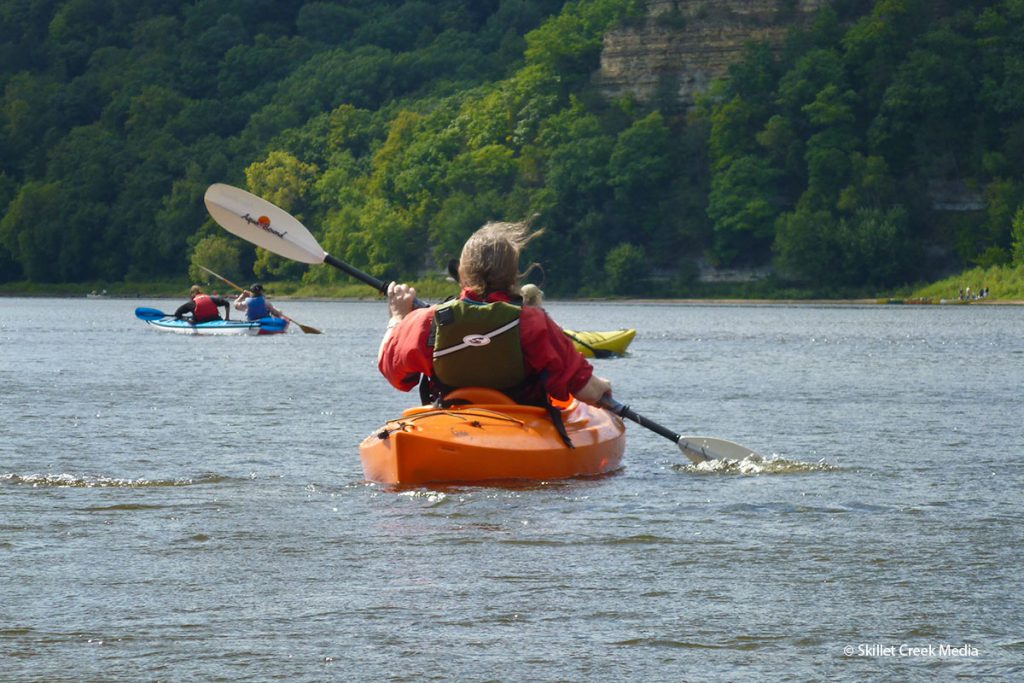
The River Studies Field Course will provide 10–20 undergraduate students, aka River Scholars, a transformative opportunity to learn about Wisconsin’s Grand Water Challenges. The course will run from August 15-19, 2026 (5-days). Accompanied by instructors and student trip leaders, scholars will embark in canoes on a river trip where they will learn basic skills in river navigation and safety while building strong teamwork and problem-solving skills. During the trip, scholars will participate in a diverse set of instructor-led field lessons and meet industry, non-profit, and agency professionals that will introduce them to careers from a variety of freshwater disciplines. The river trip will culminate with an in-depth experience on UW-La Crosse’s Research Vessel Prairie Springs, learning to use state-of-the-art river research and monitoring equipment.

Applications now accepted until March 15, 2026
- no prior experience needed
- application requires cover letter and unofficial transcripts
- open to all students in the UW-System
- students may take this course for UWL 1-credit in either Biology, Geography and Environmental Science, and Sutainability and Environmental Studies (summer tuition fee applies)
- a limited number scholarships are available
Brief Course Schedule:
Day 1
- Travel, approximately 50 minutes, from UW-La Crosse to the West Fork Sports Club by van.
- Eat packed lunch
- River Scholar orientation
- Canoe and river safety training
- Setting up camp
- Camp dinner


Day 2
- Team-building activities around the West Fork Sports Club.
- Canoe and river safety training
- Introductory lessons from instructors in West Fork Sports Club meeting space
- Camp dinner
Day 3
- Breakfast and breaking down camp
- Embark on the Lower Wisconsin River trip by canoe
- Morning River Scholar lesson
- Break for lunch
- Afternoon River Scholar lesson
- Set-up camp
- Camp dinner
Day 4
- Breakfast and breaking down camp
- Canoe
- Morning River Scholar lesson
- Break for lunch
- Afternoon River Scholar lesson
- Set-up camp
- Dinner

Day 5
- Breakfast and breaking down camp
- Canoe
- Morning River Scholar lesson
- Break for lunch
- Arrive at confluence with Mississippi River near Wyalusing State Park
- River Scholar lesson on RV Prairie Springs
- Return to UW-La Crosse by van

Lessons
Using aquatic macroinvertebrates in stream bioassessment.
Instructor Name and Department: Ross Vander Vorste (Biology)
Lesson Description: Bioassessment is an evaluation of the biological condition of a waterbody using biological surveys and other direct measurements of resident living organisms. Aquaticmacroinvertebrates are important indicators of stream health: they are relatively long-lived, differentially sensitive to environmental stressors, and relatively easy to sample. This lesson is a hands-on introduction to the use of stream macroinvertebrates in assessing a stream’s biological condition. Students will learn how to (1) sample and identify stream macroinvertebrates and (2) conduct arapid bioassessment to quantify ecosystem integrity based on the macroinvertebrate taxa that they collect. We will potentially partner with WI Department of Natural Resources Long-TermEcological Monitoring group to learn how they perform macroinvertebrate monitoring and use these data to assess ecological health of the river.
Ecology and economics of stream restoration in Wisconsin’s Driftless Area.
Instructor Name and Department: Jason Freund (Biology)
Lesson Description: The Driftless Area of Wisconsin has been greatly altered by agricultural activities and stream valleys have been fi lled with immense amounts of “cultural sediment”, the termgiven to soils from the hillslopes that were deposited in the valleys. Because of this history of degradation, it was once thought that the Driftless Area would not be able to sustain a trout fi shery.However, changes in land use, practices that reduced erosion, and stream improvement projects funded by state, federal, and non-governmental organizations like Trout Unlimited and the WestFork Sports Club have created a Driftless Area fi shery with an economic impact of well over one billion dollars annually. The “trout economy” is vital to the well-being of the Driftless Area,particularly here in the Viroqua area, often referred to as “the heart of the Driftless”. We will explore fl uvial geomorphology and how stream projects have resulted in wild, self-sustainingpopulations of native Brook Trout and non-native Brown Trout in the Viroqua / Avalanche area. Students will conduct habitat and electrofi shing surveys and use data from a stream gaging andweather station at the West Fork Sports Club to write a short collaborative report on the state of the fi shery that we can provide to the club. We will partner with employees from the USFWS Fishand Farmers Habitat Project (see attached letter of support) and potentially with volunteers at the West Fork Sports Club and the Coulee Region Chapter of Trout Unlimited.
Drone-based ecological monitoring of stream systems.
Instructor Name and Department: Niti Mishra (Geography & Environmental Science)
Lesson Description: The Driftless Area of Wisconsin features a complex network of cold-water streams that serve as critical habitats for diverse aquatic species, including native Brook Trout.Emerging drone technologies provide a transformative approach to stream monitoring by offering high-resolution, spatially explicit data on stream morphology, vegetation dynamics, and waterquality indicators. In this lesson, students will be introduced to drone-based remote sensing techniques for ecological monitoring. We will employ various drone-mounted sensors, includingmultispectral, thermal, and LiDAR cameras, to assess stream conditions, detect habitat features, and analyze compare water temperature collected in situ with thermal drone camera. Students willgain hands-on experience in mission planning, data collection, and processing techniques to extract meaningful ecological insights. We will potentially partner with local conservationorganizations, including Trout Unlimited Driftless Area Restoration Effort (TU-DARE, see attached letter of support) and WI Department of Natural Resources, to align our research with ongoingstream restoration initiatives. This collaboration will enhance student learning by linking cutting-edge technology with real-world conservation challenges in Wisconsin’s freshwater ecosystems.
Representing the river’s voice in poetry & rights of nature laws.
Instructor Name and Department: Kelly Sultzbach (English)
Lesson Description: Fiction and poetry influence what we perceive (or what remains invisible to us) when we engage with places like the Mississippi River, prompting us both to become moreaware of our own embodied selves as well as the power and agency of the river, itself. This lesson will focus on analyzing the possible dangers and potential communicative assets of literary toolssuch as personifi cation in thinking about the River as a living entity with its own needs and concerns. We will read poems about rivers by poets such as Langston Hughes and Alice Oswald, anessay by Robin Wall Kimmerer addressing positive uses of anthropomorphism in science, and an example of Ecuador’s constitutional language legally recognizing nature as its own legal entity or person. These texts will be the springboard for discussing the different uses and ethical questions related to strategies of personification; they will also serve as models for students’ own creative writing experimenting with what it might mean to imagine the river as its own being and to give it a voice.
Communicating stakeholder priorities in a complex socio-ecological river system. Instructor Name and Department: Alysa Remsburg (Sustainability & Environmental Studies)
Lesson Description: Throughout the course, scholars will sketch and note diverse river species in a small journal. They will do the same for types of human stakeholders they observe or consider. Using species observed as a starting point, the class will stand in a circle and toss a yarn ball to model a food web. Instructors will help add social dimensions to the ecological system by describing how some stakeholder groups relate to freshwater mussel management. We will focus on freshwater mussels as a case study addressing the intersection of policy and ecology. Groups of scholars will investigate different stakeholder groups and role-play for a mock public input session about fines for damage to native mussel beds. The lesson will conclude with a discussion on decision-making within complex socio-ecological systems. Students will record take-away concepts in their journals. Potential partners include Citizens Acting for Rail Safety, mussel researchers from the US Geological Survey or National Mississippi River Museum.
Importance of fungi in ecosystem functions, aquaculture, water nutrient dynamics, and human health. Instructor Name and Department: Arthur Grupe (Biology)
Lesson Description: This lesson will explore the functional ecology of fungi in river systems, emphasizing their understudied yet critical roles in organic matter processing, nutrient cycling, and trophic dynamics. Students will understand how fungal communities mediate ecosystem functions—from decomposing riparian leaf litter to altering stream dynamics through creation of large woody debris. Teams of students will engage in collecting eDNA samples, via specialized sampling equipment, from river environments at different environmental “hot spots” to contribute samples for long term monitoring projects of aquatic fungi. Students will also learn how to identify common trees in the overstory near riverbanks and some of the common fungal pathogens afflicting them through observation and inquiry exercises. Students will be able to describe the roles of different fungi and their importance in healthy ecosystem functions, aquaculture, water nutrient dynamics, and human health at the end of this lesson.
Conservation biology: The history and creation of the Lower Wisconsin Riverway. Instructor Name and Department: Jason Freund (Biology)
Lesson Description: The Lower Wisconsin State Riverway encompasses the lowest 92.5 miles of the Wisconsin River from the last dam at Sauk City to the river’s confluence with the Mississippi River at Wyalusing. Despite contentious initial meetings, the Riverway was created by bi-partisan legislation in 1989 and signed into law by then governor, Tommy Thompson. The riverway contains 95,000 acres, over 45,000 acres are in state ownership, and was created to protect and preserve the scenic beauty and natural character of the Lower Wisconsin State Riverway. The area is a Ramsar wetland of international importance and one of the largest unaltered reaches of large river in the Eastern United States. Sixty-two species of endangered, threatened or special concern status exist within the riverway boundaries. The riverway is best accessed by canoe and kayak and hosts hundreds of thousands of visitors a year while still protecting native biotic communities. Students will keep a journal of their experiences on the riverway and reflect on how these protections have created a unique setting. We will potentially partner with the Lower Wisconsin State Riverway Board, Friends of the Lower Wisconsin Riverway (FLOW), and the River Alliance of Wisconsin to invite guest visitors to further discuss this topic.
 UWL Freshwater Ecology Lab