Environmental and biological drivers of invertebrate productivity and diversity in dynamic floodplain habitats
Floodplains, the low lying areas alongside rivers periodically subject to inundation, are one of the most productive and biodiverse on earth. Naturally, river floodplains undergo dramatic changes in their environmental conditions during periods of flooding and drying throughout the year, a pattern that is becoming exacerbated by global change. More frequent and extreme floods and droughts are predicted to affect river floodplains and their biological communities . Therefore, quantifying the effects of these factors on organisms is necessary to predict changes in productivity and biodiversity in river floodplains. A long-term objective of this research is to understand the relative roles of hydrologic connectivity and duration of inundation on invertebrate productivity and diversity. Each year, we select 27 floodplain sites along a gradient of connectivity and inundation and collect adult aquatic insects. Thus far, we have captured these insects using floating and sticky traps.
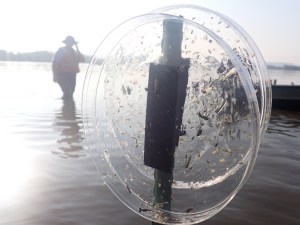
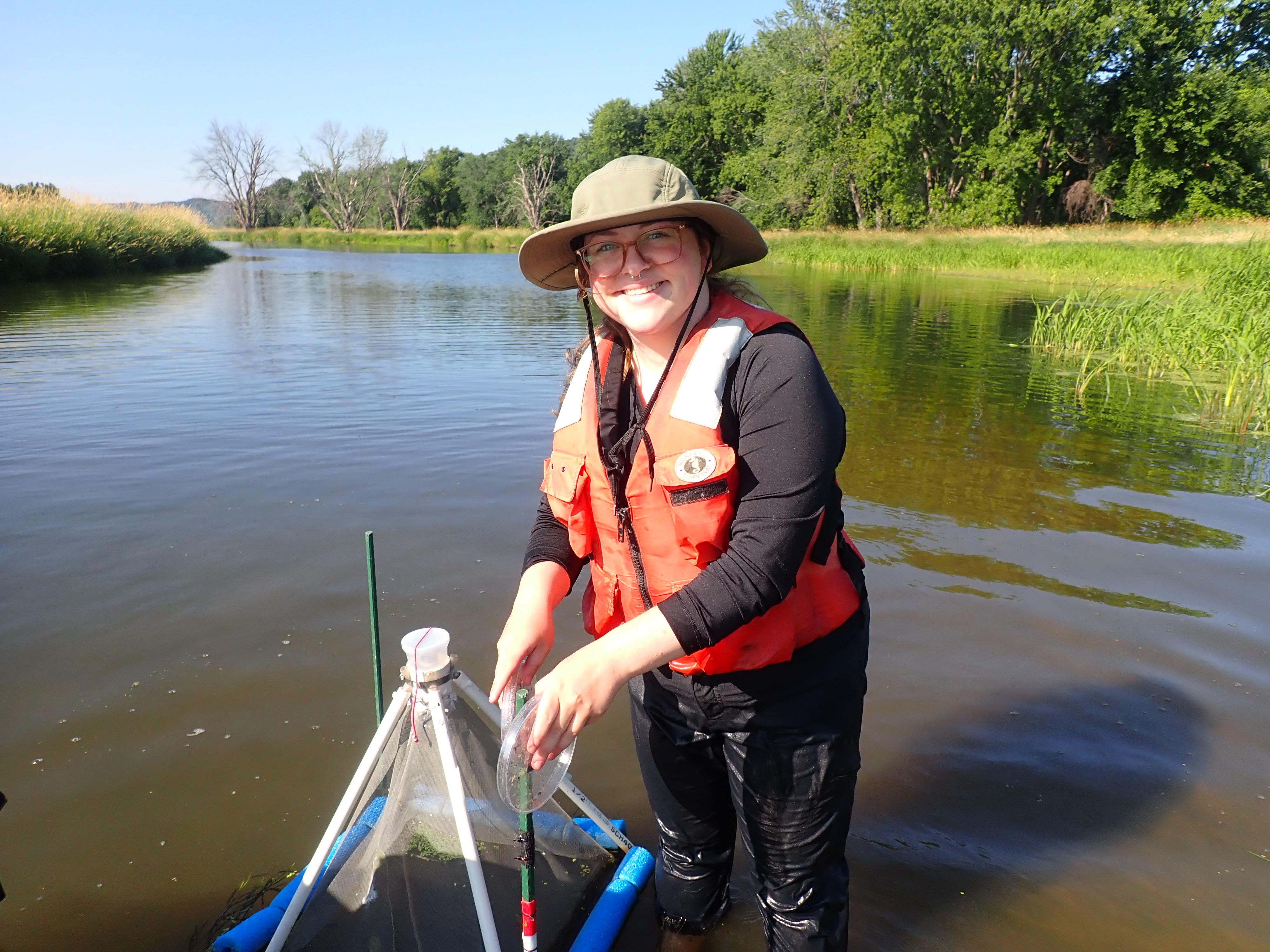
Collection of adult aquatic insects using sticky and floating emergence traps on the Upper Mississippi River.
Establishing a bloodworm (Diptera, Chironomidae) laboratory culture to facilitate aquatic research and aquaculture production.
Aquaculture operations face tremendous challenges in securing affordable and nutritious animal feed. Recent supply-chain issues, climate change, and a rising awareness of contaminants in our import-dominated food system create growing demand for local and sustainable animal feed. Bloodworms (Chironomidae; Arthropoda), one of the most abundant and ubiquitous aquatic insects worldwide, are an important nutrient source in many aquaculture operations. Bloodworms have high nutritional value, short life cycles, and broad environmental tolerance making them ideal candidates for local and sustainable animal feed production. Currently, only a few animal feed suppliers import bloodworms and this constitutes a large proportion of overall aquaculture operational costs. Our objective is to develop a bloodworm culture method that will support sustainable and productive freshwater aquaculture operations.
Mesocosms are artificial habitats used to mimic natural settings and allow for precise control of environmental variables, replicated experimental treatments. My students and I began building a novel mesocosm system in Prairie Springs Science Center. The new system has 36 individual mesocosms capable of housing both invertebrate and fish. It also has a state-of-the-art water quality monitoring system.

Aquatic mesocosm system created to facilitate ecological research and develop methods to improve aquaculture production.
Persistence of endangered Coho salmon in intermittent streams during extreme drought (postdoctoral research at UC Berkeley)
Recent droughts raise global concern over potential biodiversity loss and mitigating impacts to vulnerable species has become a management priority. However, drought impacts on populations are difficult to predict, in part, because habitat refuges can buffer organisms from harsh environmental conditions. In a global change context, more extreme droughts may turn previously suitable habitats into ecological traps, where vulnerable species can no longer persist. Here, we explore the impacts of California’s recent record-breaking drought on endangered juvenile Coho salmon. We estimated the variability of cumulative salmon survival using mark–recapture of nearly 20,000 tagged fish in intermittent stream pools during a 7-year period encompassing drought and non-drought conditions. We then determined the relative importance of physical habitat, streamflow, precipitation, landscape, and biological characteristics that may limit survival during drought.
Results from this study were published in Global Change Ecology.

Juvenile coho salmon inhabitat intermittent streams in Northern California subject to drought.
Salinization effects on biodiversity and ecosystem function (postdoctoral research at Virginia Tech)
Landscape disturbances, such as those associated with surface mining and urbanization, are a global issue of enormous scale. These disturbances often lead to degradation of freshwater ecosystems. Mountaintop mining is the process where soil and bedrock are excavated to access coal deposits and then used to fill adjancent valleys causing dramatic changes to landscapes and hydrology. Runoff from mined lands, flowing from headwater tributaries to mainstem rivers, can have high concentrations of major ions, raising salinity by orders of magnitude, and be a potential source of toxic contaminants. Biodiversity loss resulting from this stress raises concern over its potential to alter ecosystem functions, such as leaf litter decomposition. In this study, we tested the relationship between macroinvertebrate and microbial diversity and leaf litter decomposition across a mining-induced gradient of salinity in 24 Appalachian headwater streams. Leaf litter (Quercus alba) bags were deployed at each site (Fig. 1). Following collection after 30-330 days of inundation, we quantified macroinvertebrates and microbial (next-gen sequencing) diversity and leaf decomposition rates.
Results from this study are published in Freshwater Biology.

Invertebrate community resilience to river drying (Ph.D. research at University of Claude Bernard Lyon 1)
Understanding how communities respond to disturbance is essential to identifying processes that determine their assembly and to predicting the future effects of climate change on biodiversity and ecosystem functions. Drying (i.e. complete loss of surface water) is a natural disturbance affecting 50% of rivers worldwide and is increasingly occurring in perennial rivers due to climate change. Drying also represents a major challenge for aquatic communities in most river systems. However, its effects on communities and the underlying processes contributing to their resilience (i.e. return to pre-drying levels) have not been well quantified in environmentally harsh ecosystems, such as alluvial rivers. In these systems, communities could be less affected by drying because they are composed of resistant and resilient species filtered from the regional species pool.
In my thesis, I addressed the resilience of aquatic invertebrates‒a ubiquitous group involved in key ecosystem functions‒to drying in alluvial rivers. I used 4 congruous field and mesocosm experiments to quantify resilience and identify its primary sources (Figure 2). Overall, my results supported an emerging concept that harsh ecosystems are highly resilient and indicate that the effects of drying on biodiversity and ecosystem functions could vary across river systems. In alluvial rivers, the hyporheic zone can contribute strongly to community resilience and management should focus on protecting and restoring vertical connectivity to maximize resilience to climate change. Future studies may aim to examine how migration into the hyporheic zone during drying influences other important community processes, such as interspecific competition.
Results from this work have been published in 4 articles.


Manipulative field and laboratory mesocosm experiments used to quantify resilience of aquatic invertebrates to river drying.
Invertebrate diversity in headwater streams across the southeastern USA (North Carolina Division of Water Quality)
Headwater streams across the Southeast display a range of hydrologic regimes. Streams are ephemeral, intermittent, or perennial depending primarily on their geology, topography, and local climate (i.e., precipitation). Ephemeral streams are defined as conveyances of storm water runoff during and shortly after a precipitation or snowmelt event. Intermittent streams typically flow for several months out of a year but lose their surface water connection with downstream waters during the peak of the growing season and during drought. Perennial streams convey surface water throughout the entire year, except under more extreme drought conditions or, in some cases, after anthropogenic watershed alterations (NC DWQ 2005). Distinguishing between these stream types without historical knowledge requires analyzing indicators of stream geomorphology, hydrology, and biology.
In this project, we described macroinvertebrate composition and similarity in intermittent and perennial streams in over 100 streams in southeastern USA (Fig. 3). We tested the applicability of the North Carolina Methodology for Identification of Intermittent and Perennial Streams in states other than North Carolina. This information may be used by the U.S. Army Corps of Engineers (US ACE), NC DWQ, and other state biologists to make more accurate jurisdictional stream determinations and to better understand the biology of headwater streams.
Results from this work were published in an EPA final report and data is being used for an additional manuscript in preparation

Location of headwater stream sites in southeastern USA assessed for macroinvertebrate biodiversity.
Temporal changes in invertebrate communities throughout the hydroperiod in intermittent prairie streams (MS research at SDSU)
Recent literature has stressed the importance of headwater streams in freshwater ecosystem health and biodiversity. These streams contribute a globally significant amount of runoff, nutrients, and biological diversity to downstream rivers and lakes. Over half of stream miles assesseRecent literature has stressed the importance of headwater streams in freshwater ecosystem health and biodiversity. These streams contribute a globally significant amount of runoff, nutrients, and biological diversity to downstream rivers and lakes. Over half of stream miles assessed in South Dakota did not meet their beneficial uses and headwater streams may be an initial source of impairments. Many headwater streams are intermittent and contain flowing water seasonally. Intermittent streams comprise over 90% (85,000 miles) of river miles in South Dakota (Fig. 4). Intermittent streams typically progress from flowing water conditions to interstitial, pooled, and may dry depending on local climate. Physio-chemical characteristics change along with the hydrologic condition.
The objectives of this research were to describe the hydroperiod (flow length), macroinvertebrate communities and identify changes in physio-chemical parameters and community composition associated with different hydrologic conditions in intermittent streams. Sixty intermittent, headwater streams were selected in South Dakota’s Northern Glaciated Plains (NGP) ecoregion. Macroinvertebrates and physio-chemical parameters were sampled monthly at each site from April-August or until streams dried.
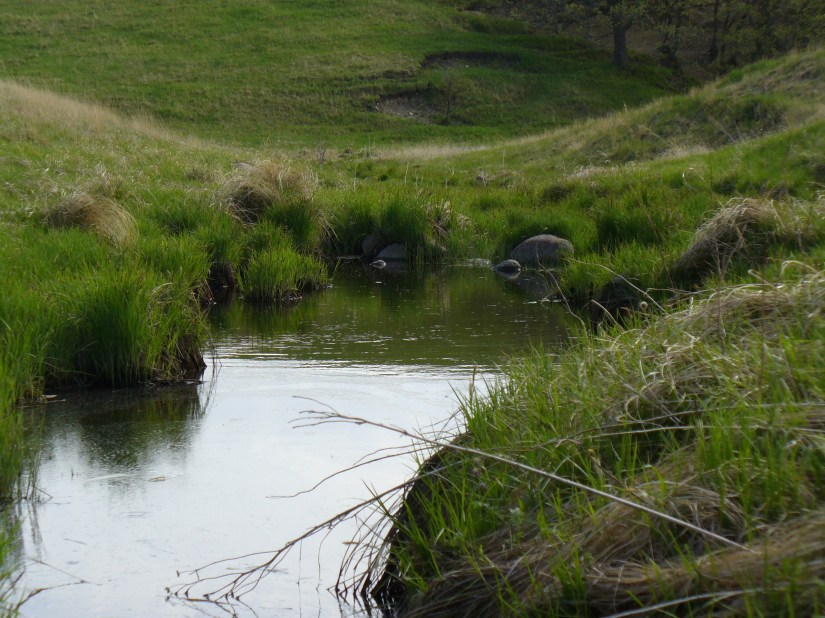
An intermittent prairie stream in northeastern South Dakota studied to understand temporal changes in macroinvertebrate communities during their April-August hydroperiod.
 UWL Freshwater Ecology Lab